+0.048ΔR · p < 10⁻⁵ ***
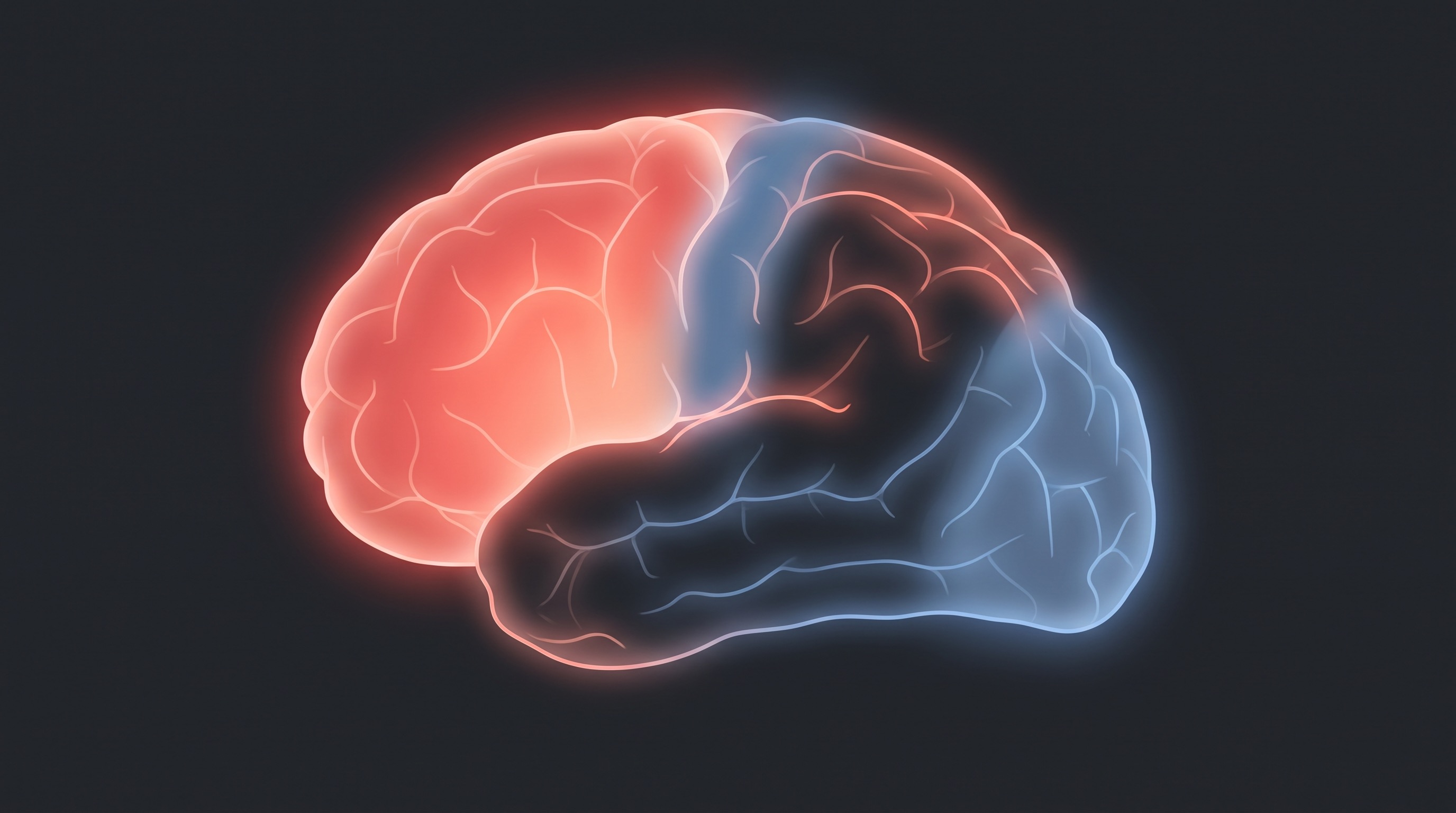
Frontoparietal Control
Holds task context, goals, and plot structure across seconds to minutes — exactly the information a memory buffer supplies.
1 / 7
Active research · Stockton University
A compact memory module that lets a state-of-the-art brain-encoding model retrieve past context — and a clean answer to where in the cortex remembering actually helps.
The Question / 01
A great film only makes sense because of what came before it. So does the brain that watches it. Current encoding models predict each moment in isolation — does giving one a memory of the recent past improve it, and where in the cortex does that memory help most?
The Architecture / 02
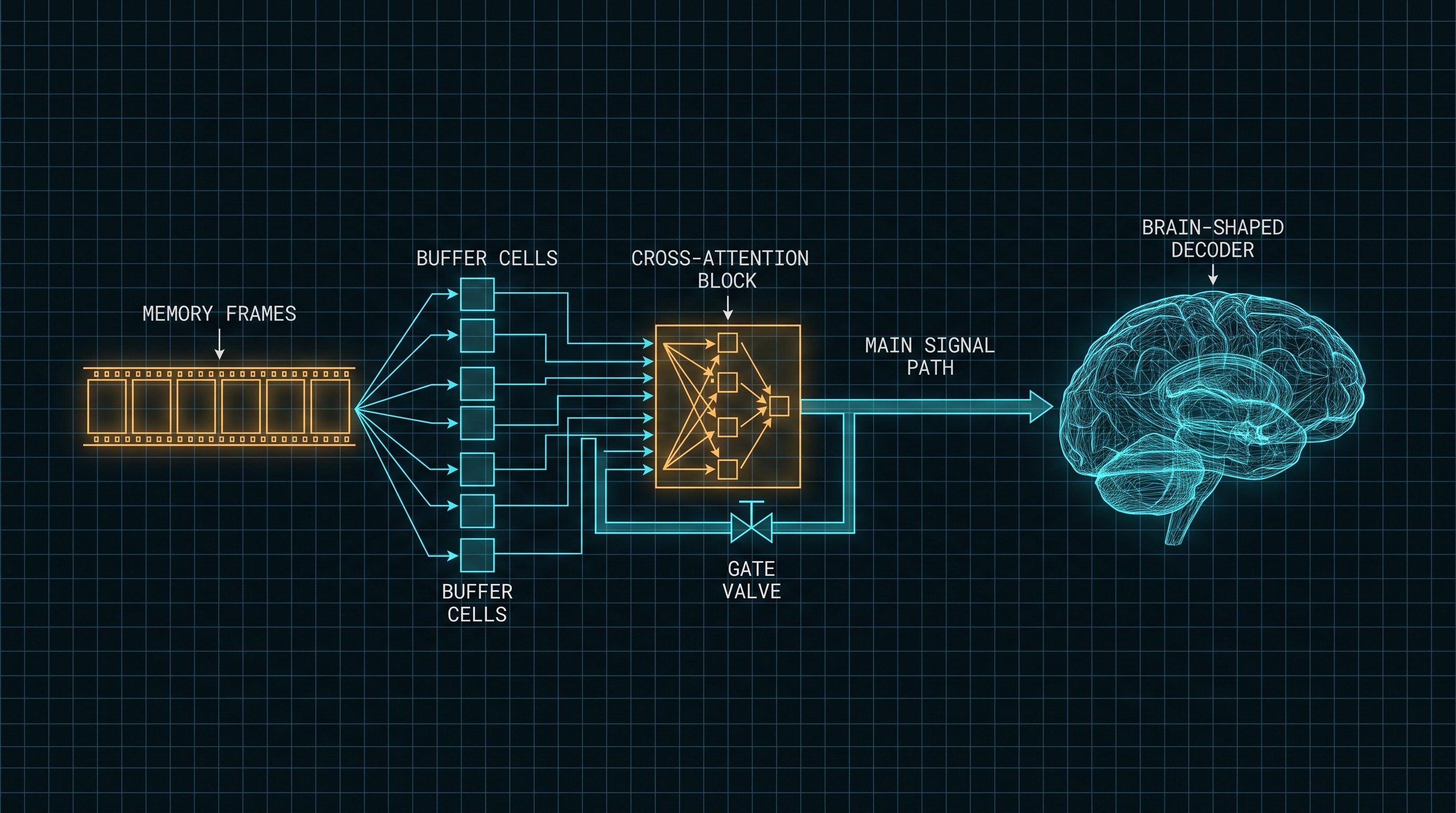
The module keeps a circular buffer of the last eight stimulus embeddings. The current moment queries them through two-head cross-attention, and a single learned gate decides how much of the retrieved past to mix back in.
The Finding / 03
The global average improvement is nearly zero — and that average lies. Split the cortex by network and two opposite effects appear: memory clearly helps the association networks that hold context, and clearly hurts the sensory networks that live in the present.
Explore the Cortex / 04
Frontoparietal Control
Holds task context, goals, and plot structure across seconds to minutes — exactly the information a memory buffer supplies.
Honest Limits / 05
The main analysis rests on a single participant's fMRI — a direction, not a population result.
Just 478 TRs (~12 minutes) of training signal constrains how much the model can learn.
Predicting a brain from a movie is hard; nobody gets high raw correlations. The honest headline is ΔR, not accuracy.
The circular memory is deliberately basic — hierarchical or consolidation-based memory may capture more.
Open Science / 06
MD Rabbi · Department of Computer Science, Stockton University · Manuscript prepared April 2026.